Binance Fees: Spot and Futures VIP Fee Tables, BNB Discount and Withdrawal Fees (2026)
Binance regular users pay 0.1% maker and taker on spot and 0.02% / 0.05% on USDT-M futures. Full VIP 0–9 tables, worked examples, how much BNB you need for the discount, USDT-M vs COIN-M, and which network has the lowest withdrawal fee.
On this page
Binance regular users pay 0.1% maker and 0.1% taker on spot, 25% less when paying in BNB. USDT-M futures cost 0.02% maker and 0.05% taker, 10% less with BNB. Futures fees are charged on position value, so opening and closing a 10,000 USDT position as taker costs about 10 USDT.
This guide uses screenshots of the official pages to cover the spot and futures VIP tiers, how fees are calculated, how much BNB the discount needs, how USDT-M and COIN-M futures differ, and how to pick a withdrawal network. Regular-user rates follow the exchange's fee page (last checked 2026-10-28); the VIP tables and trading parameters were checked against Binance's fee page on 9 November 2026.
Regular-user rates
| Product | Maker | Taker | Paying in BNB |
|---|---|---|---|
| Spot & margin | 0.1% | 0.1% | 25% off |
| USDT-M futures (stablecoin margin) | 0.02% | 0.05% | 10% off |
| COIN-M futures (coin margin) | 0.0200% | 0.0500% | No BNB column in the fee table |
- Maker: your limit order rests on the order book and adds liquidity, so it pays less.
- Taker: a market order, or a limit order that fills immediately, removes liquidity and pays more.
For regular users spot maker and taker cost the same, while futures taker is 2.5× maker — so on futures, resting limit orders save the most.
Binance spot fee VIP table
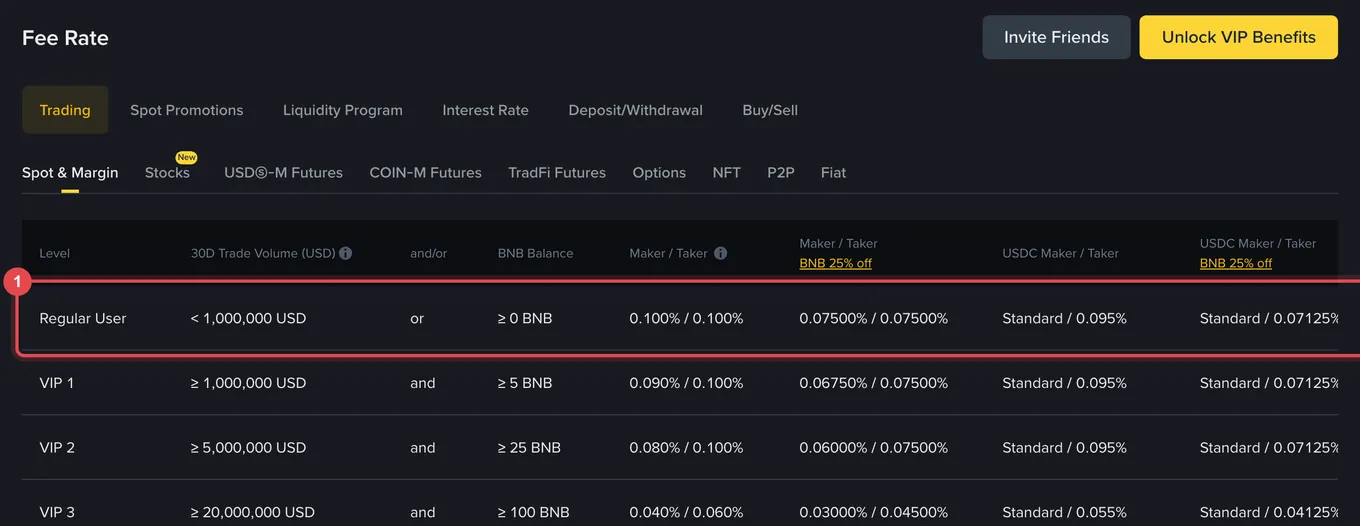
All tiers, checked 9 November 2026 (30-day volume counts spot, margin, Convert, copy trading and trading bots):
| Tier | 30-day spot volume (USD) | and BNB balance | Maker / taker | With BNB |
|---|---|---|---|---|
| Regular | < 1M | — | 0.100% / 0.100% | 0.0750% / 0.0750% |
| VIP 1 | ≥ 1M | ≥ 5 | 0.090% / 0.100% | 0.0675% / 0.0750% |
| VIP 2 | ≥ 5M | ≥ 25 | 0.080% / 0.100% | 0.0600% / 0.0750% |
| VIP 3 | ≥ 20M | ≥ 100 | 0.040% / 0.060% | 0.0300% / 0.0450% |
| VIP 4 | ≥ 75M | ≥ 500 | 0.040% / 0.052% | 0.0300% / 0.0390% |
| VIP 5 | ≥ 150M | ≥ 1,000 | 0.025% / 0.031% | 0.01875% / 0.02325% |
| VIP 6 | ≥ 400M | ≥ 1,750 | 0.020% / 0.029% | 0.0150% / 0.02175% |
| VIP 7 | ≥ 800M | ≥ 3,000 | 0.019% / 0.028% | 0.01425% / 0.0210% |
| VIP 8 | ≥ 2B | ≥ 4,500 | 0.016% / 0.025% | 0.0120% / 0.01875% |
| VIP 9 | ≥ 4B | ≥ 5,500 | 0.011% / 0.023% | 0.00825% / 0.01725% |
Three things to notice:
- Volume and BNB are both required: VIP 1 needs at least $1M of 30-day spot volume and at least 5 BNB. Holding BNB without the volume keeps you at the regular rate.
- VIP 1 and VIP 2 only cut maker: taker stays at 0.100% until VIP 3.
- USDC pairs are priced separately: regular-user taker on USDC pairs is 0.095%, or 0.07125% with BNB.
Binance futures fee VIP table (USDT-M)
USDT-M futures rates are on the same page under the USDⓈ-M Futures tab:
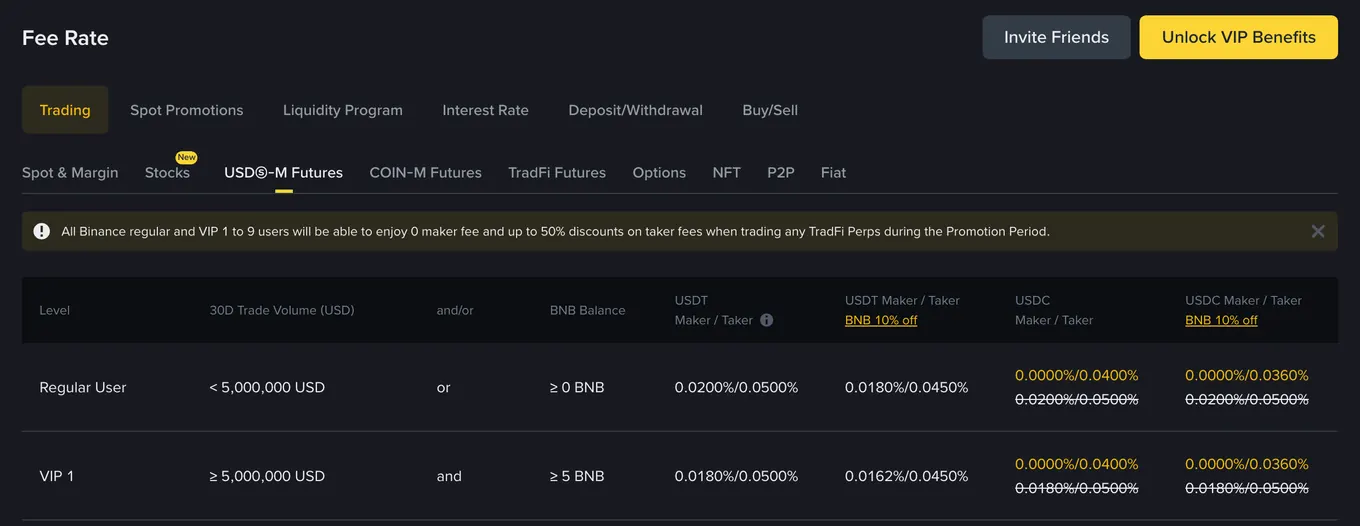
All tiers, checked 9 November 2026 (30-day volume combines USDT-M and COIN-M futures):
| Tier | 30-day futures volume (USD) | and BNB balance | Maker / taker | With BNB (10% off) |
|---|---|---|---|---|
| Regular | < 5M | — | 0.0200% / 0.0500% | 0.0180% / 0.0450% |
| VIP 1 | ≥ 5M | ≥ 5 | 0.0180% / 0.0500% | 0.0162% / 0.0450% |
| VIP 2 | ≥ 10M | ≥ 25 | 0.0160% / 0.0400% | 0.0144% / 0.0360% |
| VIP 3 | ≥ 50M | ≥ 100 | 0.0120% / 0.0320% | 0.0108% / 0.0288% |
| VIP 4 | ≥ 600M | ≥ 500 | 0.0100% / 0.0300% | 0.0090% / 0.0270% |
| VIP 5 | ≥ 1B | ≥ 1,000 | 0.0080% / 0.0270% | 0.0072% / 0.0243% |
| VIP 6 | ≥ 2.5B | ≥ 1,750 | 0.0060% / 0.0250% | 0.0054% / 0.0225% |
| VIP 7 | ≥ 5B | ≥ 3,000 | 0.0040% / 0.0220% | 0.0036% / 0.0198% |
| VIP 8 | ≥ 12.5B | ≥ 4,500 | 0.0020% / 0.0200% | 0.0018% / 0.0180% |
| VIP 9 | ≥ 25B | ≥ 5,500 | 0.0000% / 0.0170% | 0.0000% / 0.0153% |
Compared with spot:
- Higher volume thresholds: VIP 1 needs $1M on spot but $5M on futures; the BNB requirement is the same (5 BNB for VIP 1).
- Smaller BNB discount: 25% off on spot, only 10% off on USDT-M futures.
- Promotional rates on USDC- and USD1-margined contracts: at the time of capture the fee page showed 0 maker and up to 50% off taker for these contracts. It is a time-limited promotion; check the notice on the fee page.
USDT-M vs COIN-M futures fees
Binance has two kinds of futures. The fee tiers are the same; what differs is the margin asset and the currency the fee is charged in:
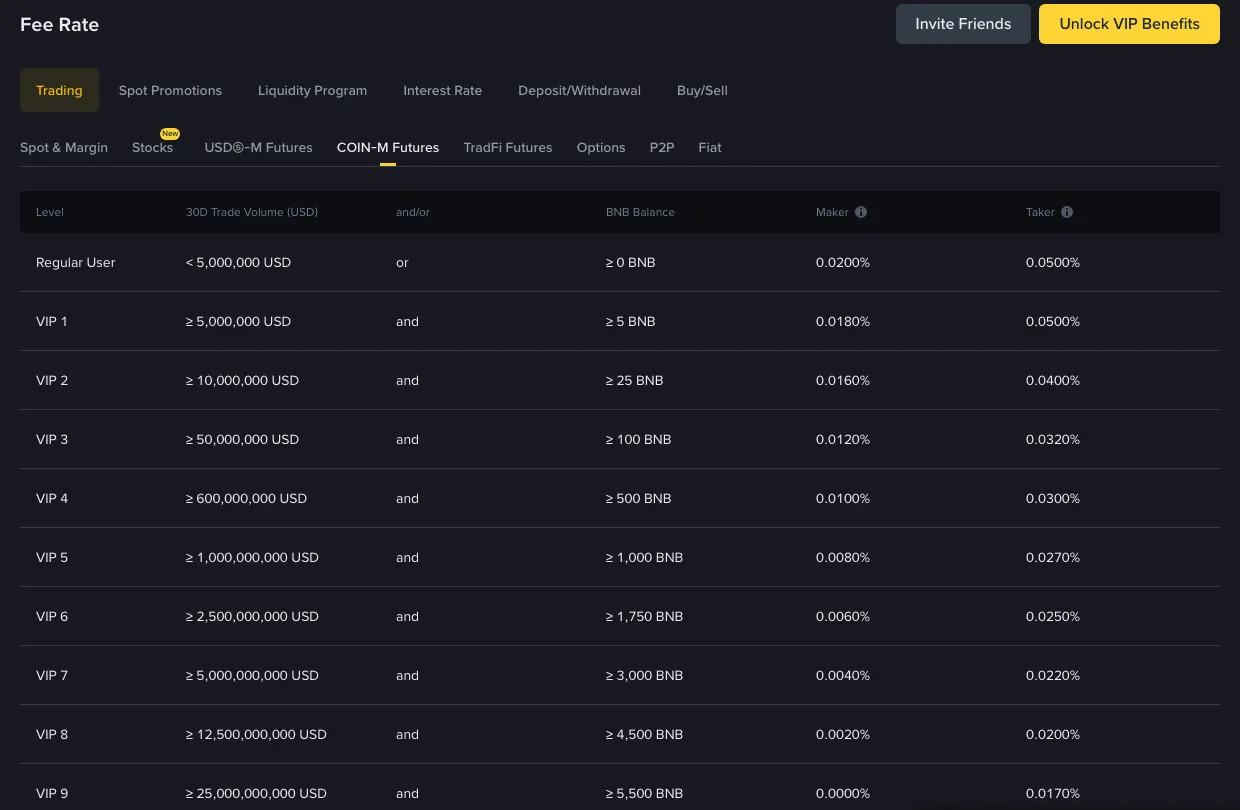
| USDT-M futures | COIN-M futures | |
|---|---|---|
| Margin | USDT, USDC or other stablecoins | The coin itself, e.g. BTC or ETH |
| PnL settled in | Stablecoin | The coin |
| Fee charged in | Stablecoin (or BNB if enabled) | The coin |
| Regular maker / taker | 0.02% / 0.05% | 0.0200% / 0.0500% |
| BNB discount | Yes, 10% off | No BNB column in the fee table |
| VIP volume | Combined across both | Combined across both |
| Suits | Most users — PnL is in USDT | People who already hold BTC or ETH and want to use it as margin or measure returns in coin |
COIN-M example: with BTC at 100,000 USDT, a COIN-M position worth $10,000 pays a taker fee of 10,000 × 0.05% = $5, deducted as roughly 0.00005 BTC from your BTC margin. If the coin price falls, the same position value costs more coins in fees.
For beginners, USDT-M is easier to reason about — PnL and fees are both in USDT — and BNB saves 10%. See perpetual futures basics for the core concepts.
How fees are calculated: spot and futures examples
Fee = trade value × fee rate; for futures, trade value is position value (not margin)
1. Spot market buy. Buying 1,000 USDT of BTC at the taker rate of 0.1% costs 1,000 × 0.1%. Without the BNB discount the fee comes out of the BTC you receive; with it, BNB is deducted instead, at a discount. When you sell, the fee comes out of the USDT you receive.
2. Spot limit order. A resting limit order is charged the maker rate of 0.1% when it fills. For regular users spot maker and taker are the same; the gap widens at higher VIP tiers.
3. Futures open and close. 1,000 USDT of margin at 10× is a 10,000 USDT position, charged once on open and once on close. At November 2026 rates, one round trip costs:
| Order type | Regular | Regular + BNB | VIP 1 |
|---|---|---|---|
| Taker in, taker out | 5 + 5 = 10 USDT | 4.5 + 4.5 = 9 USDT | 5 + 5 = 10 USDT |
| Maker in, taker out | 2 + 5 = 7 USDT | 1.8 + 4.5 = 6.3 USDT | 1.8 + 5 = 6.8 USDT |
| Maker in, maker out | 2 + 2 = 4 USDT | 1.8 + 1.8 = 3.6 USDT | 1.8 + 1.8 = 3.6 USDT |
Futures VIP 1 keeps the regular taker rate and only cuts maker, so for a regular user the BNB discount and more maker orders matter far more than chasing VIP. Higher leverage means more fees for the same margin.
Monthly example: 1M USDT of futures volume in a month (opens and closes both count) costs 500 USDT all as taker, 450 USDT with BNB; all as maker it is 200 USDT, or 180 USDT with BNB. Futures VIP 1 needs $5M of 30-day volume and 5 BNB.
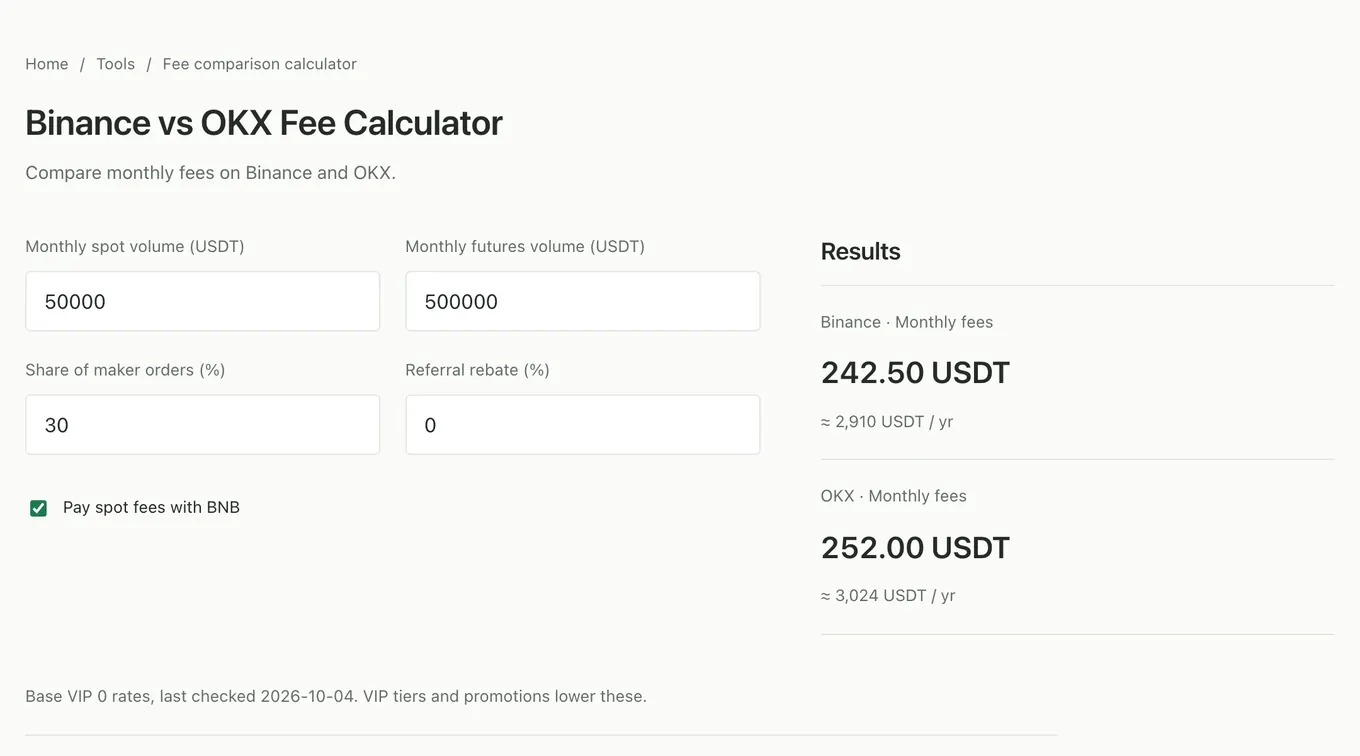
Work out your own monthly fees — and the difference versus OKX — with the fee calculator:
What you pay per month at different volumes
At current regular-user rates, all as taker (updated automatically):
| Monthly volume | Spot (taker) | Spot (paid in BNB) | Futures (taker) | Futures (maker) |
|---|---|---|---|---|
| 10,000 USDT | 10.00 USDT | 7.50 USDT | 5.00 USDT | 2.00 USDT |
| 100,000 USDT | 100 USDT | 75.00 USDT | 50.00 USDT | 20.00 USDT |
| 1,000,000 USDT | 1,000 USDT | 750 USDT | 500 USDT | 200 USDT |
| 10,000,000 USDT | 10,000 USDT | 7,500 USDT | 5,000 USDT | 2,000 USDT |
Two things stand out: under 100,000 USDT of monthly spot volume, fees are tens of USDT and BNB saves a quarter; futures volume is usually many times larger, so maker vs taker on futures is what really matters — on 1M USDT of futures volume, all-maker costs less than half of all-taker.
The real cost of one futures trade
Say you open a 10× BTC long with 1,000 USDT of margin (10,000 USDT position), hold it for 3 days and close, with funding at +0.01% per 8 hours throughout:
- Open as taker: 10,000 × 0.05%
- Close as taker: the same again
- Funding: 9 settlements of 10,000 × 0.01% = 1 USDT each, about 9 USDT
Fees plus funding come to nearly 20 USDT — about 2% of your margin — so the price has to rise about 0.2% just to break even. The longer you hold, the more funding dominates; see funding rates explained.
BNB fee discount: how to enable it and how much BNB you need
- Three separate switches: spot trading fees (25% off), margin interest (5% off) and USDT-M futures fees (10% off) each have their own toggle.
- No minimum BNB balance: the discount applies whenever the right wallet holds enough BNB to cover that fee. Spot deducts from the spot wallet; futures usually needs BNB in the futures wallet. When it runs out, fees fall back to the traded asset.
- 5 BNB is the VIP 1 threshold, not a discount threshold: the BNB balance column in the fee table only decides VIP tier, and only together with volume.
- How much to keep: at the regular BNB rate of 0.075%, every 10,000 USDT of spot volume uses about 7.5 USDT of BNB. Estimate your monthly volume and keep a month or two's worth; there's no need to stockpile BNB just for fees.
- BNB in Earn still works for you: BNB in Simple Earn qualifies for HODLer airdrops — see Binance Launchpool and HODLer airdrops — so keep only a small amount in spot for fees.
What is the minimum BNB purchase on Binance?
On the spot BNB/USDT pair, the trading parameters page says (checked 9 November 2026):
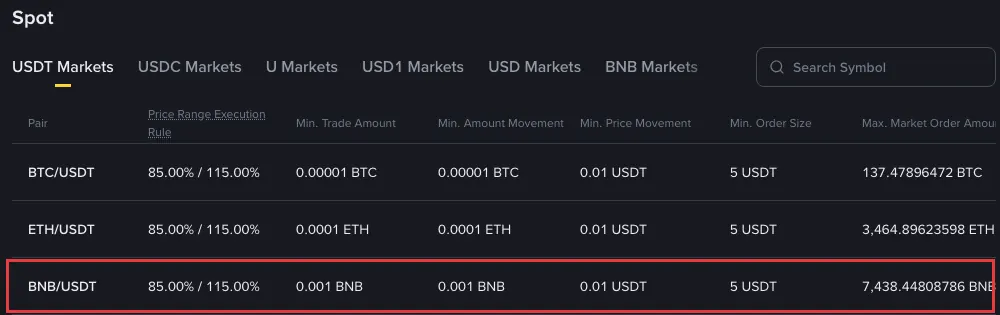
- Minimum order size 5 USDT: an order's total value can't be below 5 USDT.
- Minimum quantity 0.001 BNB, in steps of 0.001 BNB.
- Both apply: unless BNB trades above 5,000 USDT, 0.001 BNB is worth less than 5 USDT, so the 5 USDT rule is the one you hit first.
If you only want BNB for fee discounts, a 10–20 USDT purchase usually lasts a regular user a while. Convert and Buy Crypto also sell small amounts of BNB, but the cost is built into the quoted spread — see "Easy-to-miss costs" below.
How Binance VIP tiers are assessed
From the fee page (checked November 2026):
- Volume and BNB balance: both conditions must be met for a tier; you're a regular user if volume is below the threshold or the BNB balance isn't met.
- Spot and futures volume are separate: spot volume includes spot, margin, Convert, copy trading and bots; futures volume combines USDT-M and COIN-M. Both are valued in USD.
- Benefits apply everywhere: the fee page notes that VIP fees and benefits from any VIP programme apply to all Binance products.
- Based on the last 30 days, with fee changes applied automatically the next day.
For most individuals the thresholds are high, so the tips below matter more.
How to pay less
| Method | Who it suits | Saving |
|---|---|---|
| BNB discount | Spot and USDT-M futures traders | 25% off spot, 10% off USDT-M futures |
| Limit (maker) orders | Trades that aren't urgent | Regular futures maker is 60% cheaper than taker |
| Referral code at sign-up | New users | Some programmes return part of your fees — see the Binance sign-up guide |
| Zero-fee promotions | Traders of the promoted pairs | No or reduced fees on those pairs |
| Trade futures less often | Futures traders | Each avoided round trip saves two fees |
To enable the BNB discount, switch on "Use BNB to pay for fees" in fee settings and keep some BNB in your spot wallet. When BNB runs out, fees are charged in the traded asset again.
Easy-to-miss costs
Withdrawal fees: which network to use for USDT
Binance doesn't charge for crypto deposits. Withdrawal fees are a fixed amount per coin and network, independent of the amount — withdrawing 100 USDT costs the same as 10,000 USDT. The fee page also says fees are set by the network and may change without notice when it's congested; the withdrawal page shows the live fee.
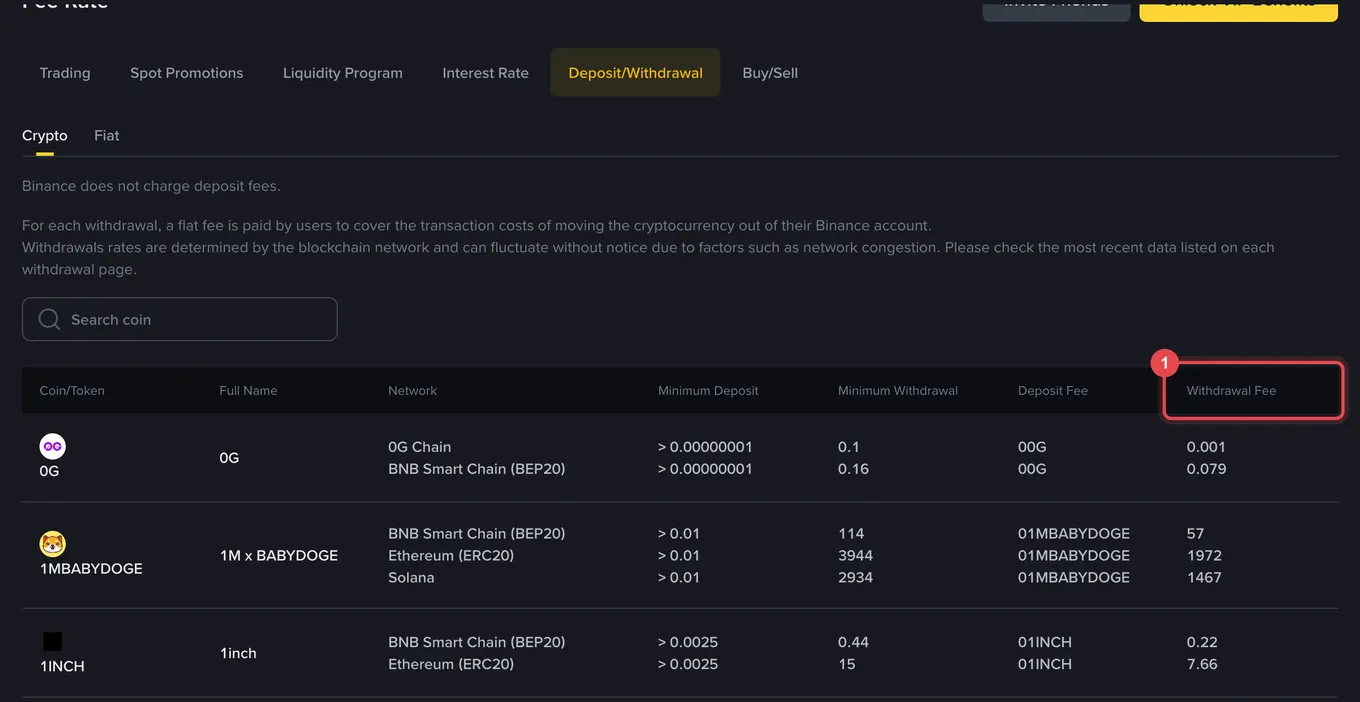
Common networks for USDT:
| Network | What to know | Watch out for |
|---|---|---|
| BNB Smart Chain (BEP20) | At the time of capture the withdrawal page said USDT on BSC had the lowest fee | The receiving side must support BEP20 |
| Tron (TRC20) | Widely supported; in our October 2026 capture the fee was 1.50 USDT with a 5 USDT minimum | Fees change with network conditions |
| Solana, Arbitrum, Polygon, etc. | Usually cheap on-chain | Check the receiving platform accepts deposits on that network |
| Ethereum (ERC20) | Most widely supported, usually the most expensive | Poor value for small transfers |
| Binance user (internal transfer) | The "Binance user" option on the withdrawal page sends to another Binance account without going on-chain | Only works between Binance accounts |
Pick a network by checking which ones the receiver supports, then switching between them on Binance's withdrawal page to compare the fee and minimum shown. Both sides must use the same network — see how to transfer from Binance to OKX.
Convert and Buy Crypto
No separate fee is shown; the cost is in the quoted spread. For larger amounts a spot order is usually cheaper.
Slippage
Thin order books on small tokens mean large market orders fill well away from the last price. Split orders or use limits.
Funding
Holding a perpetual through settlement pays or receives funding, which can outweigh trading fees — see funding rates explained.
FAQ
What is the Binance spot trading fee?
Regular users pay 0.1% maker and 0.1% taker, 25% less when paying with BNB. VIP 1 needs $1M of 30-day spot volume and 5 BNB, and cuts maker to 0.090%.
How are Binance futures fees calculated?
Position value × fee rate, charged at open and at close. Regular USDT-M rates are 0.02% maker and 0.05% taker, 10% less with BNB. A 10,000 USDT position opened and closed as taker costs about 10 USDT.
How much BNB do I need to hold for the fee discount?
There's no minimum — any BNB in the right wallet that covers the fee is used. The 5 BNB in the fee table is the VIP 1 requirement, and it only counts together with trading volume.
What is the minimum amount of BNB I can buy on Binance?
On spot BNB/USDT the minimum order is 5 USDT, with a minimum quantity of 0.001 BNB in steps of 0.001 BNB (trading parameters page, 9 November 2026).
Are USDT-M and COIN-M futures fees the same?
Regular-user rates are the same — 0.02% maker, 0.05% taker — and the VIP tiers match. COIN-M uses the coin as margin and charges fees in it, with no BNB discount in the fee table; USDT-M charges stablecoin and gives 10% off with BNB.
Which network has the lowest USDT withdrawal fee on Binance?
Check the withdrawal page for the live fee. At the time of capture Binance's withdrawal page said BSC (BEP20) had the lowest USDT fee — as long as the receiver supports it and both sides use the same network.
I enabled the BNB discount but it isn't applied — why?
Check there's enough BNB in the right wallet — spot for spot fees, futures for futures fees; otherwise fees fall back to the traded asset.
Where can I see the fees I paid?
Order and trade history show the fee and fee currency for every fill.
Is Binance or OKX cheaper?
Regular futures fees are identical and spot fees are close; see Binance vs OKX and the OKX fees guide.