What Is the Funding Rate? Positive vs Negative, How It's Calculated, Settlement Times and APR
How perpetual futures funding rates work: what positive and negative rates mean, how much you pay per settlement, settlement intervals and annualizing, what drives the rate, and reading market sentiment from funding.
On this page
Perpetual futures never expire, so their price can drift away from spot. Exchanges pull them back with the funding rate: longs and shorts pay each other periodically, and the exchange keeps none of it. Understanding funding stops a long-held position from bleeding slowly and lets you read market sentiment.
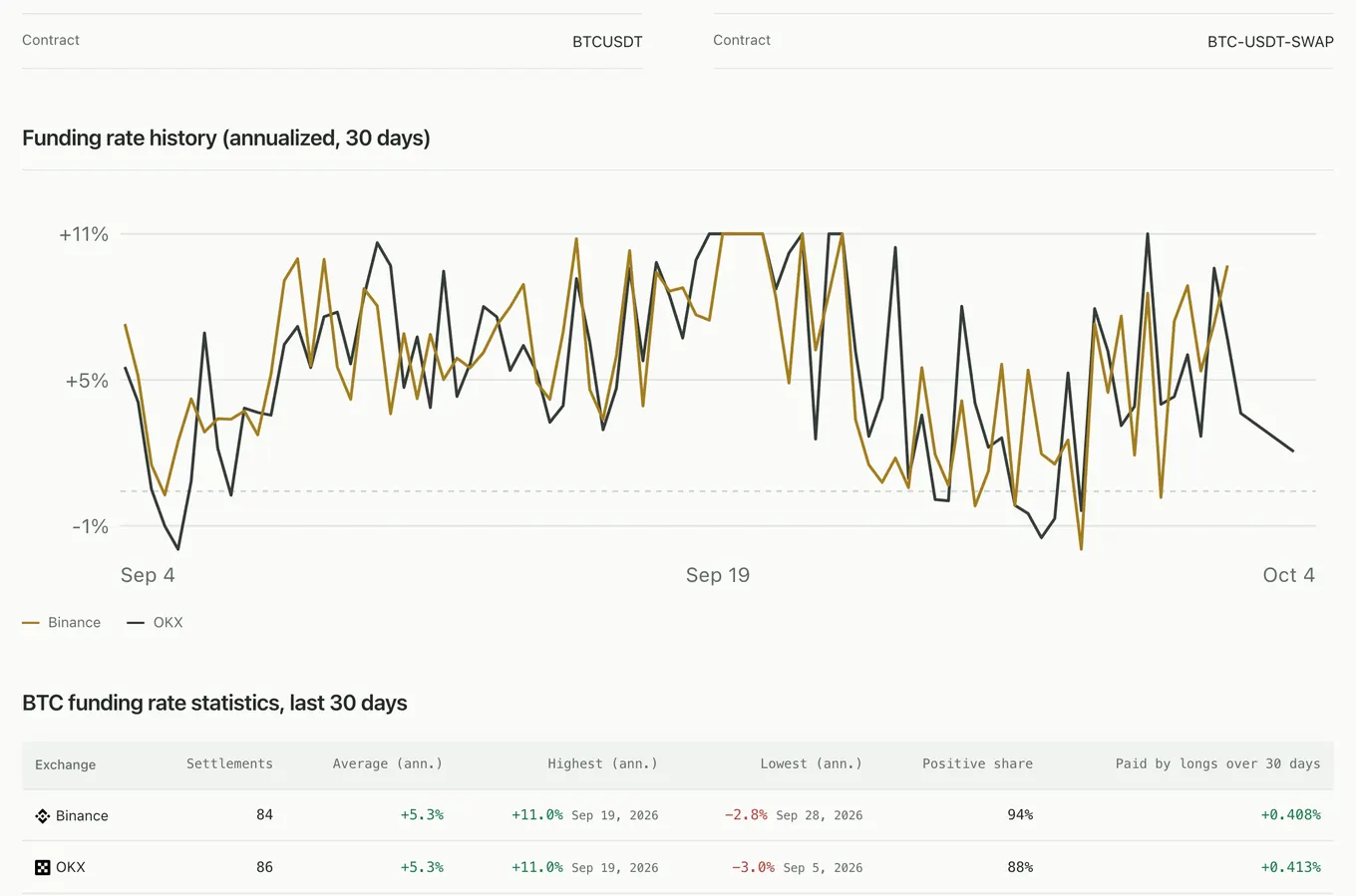
Our funding rate table lists the current rate, annualized rate and 7-day average for every USDT-margined perpetual on Binance and OKX, and each coin has its own page with a 30-day chart and statistics.
What positive and negative rates mean
- Positive: the perpetual trades above spot, so longs pay shorts — longs are crowded.
- Negative: the perpetual trades below spot, so shorts pay longs.
- Only at settlement: close before settlement and you don't pay that period; open after it and nothing happens until the next one.
How much you pay
Funding payment = position value × funding rate
Holding a 10,000 USDT BTC long at +0.01% costs 1 USDT for that period; a short receives 1 USDT. It's based on position value, not margin, so higher leverage means more funding for the same margin.
Intervals and annualizing
Most contracts settle every 8 hours; volatile coins may settle every 4 hours or even hourly. Rates on different intervals can't be compared directly, so we annualize:
Annualized = rate per period × settlements per day × 365
| Rate per period | Interval | Annualized |
|---|---|---|
| 0.01% | 8 h | ~10.95% |
| 0.01% | 4 h | ~21.9% |
| 0.1% | 8 h | ~109.5% |
| -0.05% | 1 h | ~-438% |
The current rate is noisy. To judge whether a coin's funding is persistently high, look at the 7-day settled average and the share of positive settlements over 30 days — both are on each coin's funding page.
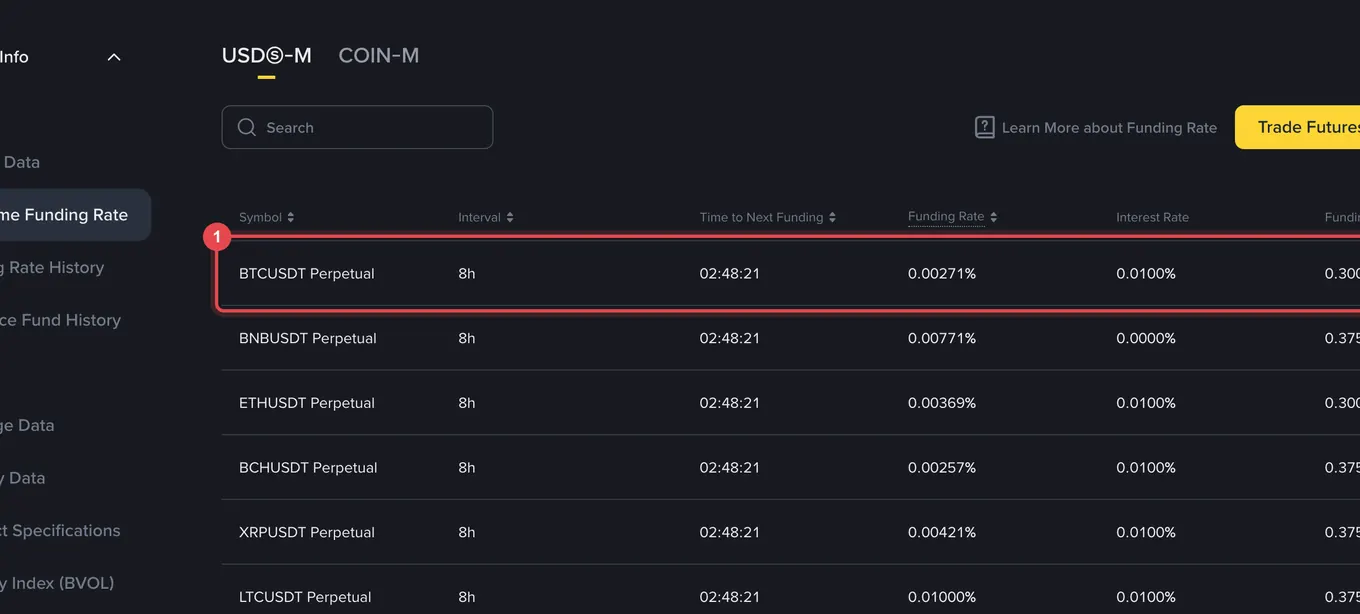
The exchanges also show each contract's current rate and next settlement:
What drives the rate
Exchange formulas have two main parts:
- Premium index: how far the perpetual trades from the spot index; the more expensive the perpetual, the higher the rate.
- Interest component: a small fixed value, which is why balanced major coins tend to sit at a small positive rate.
Each contract also has a cap and floor; in extreme moves the rate hits the cap, and some exchanges shorten the settlement interval when it stays there.
Reading sentiment from funding
- Widespread high positive rates: crowded longs, often after a sharp rally, with risk of cascading long liquidations on a pullback.
- Persistent negative rates on new tokens: common after listings — heavy shorting, or users hedging airdropped or farmed spot tokens.
- Big gaps between exchanges: different positioning on each venue and potential cross-exchange arbitrage — see the funding arbitrage guide and the spread page.
Paying less funding
- Check the current rate and next settlement before opening.
- Short-term traders can avoid holding through settlement.
- For long holds on the expensive side, count funding as a cost — or use the exchange with the lower rate.
The most extreme funding right now
Among the top 100 contracts by volume, the highest and lowest annualized rates (live):
| Coin | Binance (ann.) | OKX (ann.) | Binance 7d avg | OKX 7d avg |
|---|---|---|---|---|
| INIT | -628.8% | -915.7% | -679.7% | -545.9% |
| SAHARA | -508.3% | -555.1% | +4.4% | -3.9% |
| ONE | -533.3% | -340.2% | -92.8% | -77.8% |
| BREV | -496.9% | -479.9% | -829.4% | -775.6% |
| ENSO | -327.0% | -408.9% | -645.5% | -616.1% |
| BARD | -266.3% | -207.9% | -797.1% | -858.0% |
Each coin's page has a 30-day chart and settlement statistics, which say more than the current rate:
FAQ
Does the exchange collect funding?
No. Funding moves between longs and shorts; the exchange takes no cut.
How often is funding settled?
Every 8 hours for most contracts, 4 hours or 1 hour for some. Our table shows each contract's interval and next settlement.
If funding is negative, do longs make money?
Longs receive funding, but price losses are usually far larger than funding income — don't pick a direction on funding alone.