OKX Trading Competition (Trade-to-Earn) Guide: Volume Threshold, Prize Split and Payout
How to join an OKX trading competition (Trade-to-Earn): registering, reaching the volume threshold, how the prize pool is split and when rewards arrive, with real recent pools, a cost estimate and common mistakes.
On this page
Most OKX trading competitions are called Trade-to-Earn: register for the campaign, trade the eligible token during the campaign period, and once your volume reaches the threshold you share the prize pool under that round's rules. Before joining, check four things: whether you need to register, the minimum volume, which pairs and order types count, and how the pool is split. Whether it pays off depends on the reward being worth more than the fees, slippage and price risk you take on to generate the volume.
This guide is based on the OKX competitions we have tracked (as of November 2026); pools, dates and thresholds below are taken from each round's official OKX announcement. It covers how to read the rules and do the maths. Live OKX campaigns are on our OKX page, and both exchanges' competitions are on the trading competitions page. For Binance tournaments, see how Binance and OKX trading competitions work.
Types of OKX trading competition
OKX announcements use three kinds of titles. The rules are similar; the difference is the market and the reward token:
| Type | Typical announcement title | Trades that count | Reward |
|---|---|---|---|
| Trade-to-Earn | OKX × CT Trade-to-Earn: Trade to Share 1,000,000 CT | Spot pairs of the listed token | Usually the project token |
| Spot trading competition | OKX × CARDS spot trading competition: share 500,000 USDT | Spot pairs of the listed token | Project token or USDT |
| Perpetual Trade-to-Earn | OKX × XDP Perpetual Trade-to-Earn: Trade to Share 15,000,000 XDP | Perpetual futures of the token | Usually the project token |
Versions in Thai, Vietnamese and other languages carry the same rules; the English announcement is the reference.
Recent OKX trading competitions: pools and dates
A selection of OKX competitions we have tracked. Pools and campaign periods are as stated in each official announcement (times in UTC):
| Announced | Campaign | Prize pool | Campaign period (UTC) |
|---|---|---|---|
| 2026-10-29 | OKX × XDP Perpetual Trade-to-Earn | 15,000,000 XDP | Oct 29 10:00 – Nov 4 10:00 |
| 2026-10-15 | OKX × CT Trade-to-Earn | 500,000 CT | Oct 15 10:00 – Oct 22 10:00 |
| 2026-09-30 | OKX × CT Trade-to-Earn | 1,000,000 CT | Sep 30 10:00 – Oct 7 10:00 |
| 2026-09-28 | OKX × XDP Trade-to-Earn | 20,000,000 XDP | Sep 28 13:00 – Oct 5 13:00 |
| 2026-09-02 | OKX × CP Trade-to-Earn | 10,000,000 CP | Sep 2 14:30 – Sep 14 14:30 |
| 2026-07-06 | OKX × RE Trade-to-Earn | 1,000,000 RE | Jul 6 10:00 – Jul 16 10:00 |
| 2026-06-30 | OKX × TAO spot competition | 300,000 USDT | Jun 30 – Jul 13 |
| 2026-06-25 | OKX × CARDS spot competition | 500,000 USDT | Jun 25 – Jul 8 |
| 2026-06-18 | OKX × RE spot competition | 2,400,000 RE | Jun 18 – Jun 29 |
A few patterns stand out:
- They are frequent. The nine rounds above were announced between June 18 and October 29, 2026, so missing one is not a big deal — another usually follows within weeks.
- Each round in the table runs 6–13 days, and every one was announced on the day it started, so there is little advance notice.
- The same token often gets several rounds, and later pools tend to be smaller: CT went from 1,000,000 CT to 500,000 CT, RE from 2,400,000 RE to 1,000,000 RE. XDP had a spot round first, then a perpetual round.
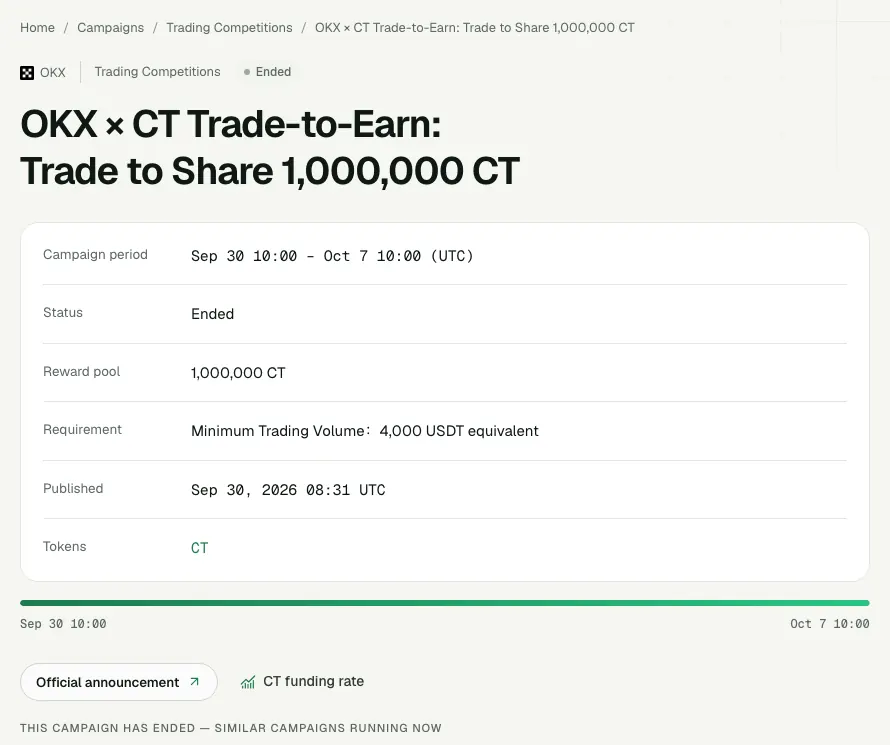
- Thresholds are in USDT equivalent — the official announcement for the September 30 CT round states "Minimum Trading Volume: 4,000 USDT equivalent".
Each round's threshold, pool and comparison with earlier rounds is on its campaign page:
How to take part, step by step
- Have a verified OKX account. Most campaigns require identity verification, and users in the restricted countries and regions listed in the announcement cannot take part. New to OKX? See the OKX sign-up guide.
- Open the official announcement and register on the campaign page. The CT and RE Trade-to-Earn rounds we tracked all required registration first, and trades before registering do not count. Register first, trade second.
- Move USDT to your trading account. Spot rounds use USDT in your trading account; perpetual rounds also need the right account mode. Moving funds from Binance? See Binance to OKX transfers.
- Trade the listed pair until you reach the threshold. Only the pairs in the announcement count (e.g. CT/USDT). Whether Convert, quick buy, copy trading or trading bots count depends on the announcement — when in doubt, use ordinary spot limit or market orders.
- Stop once you qualify. If qualifying users split the pool equally, extra volume only adds cost. Keep going only if you are chasing a ranking prize.
- Wait for the payout. Rewards are paid on the schedule in the announcement; announcements typically state that accounts with wash trading or self-trading are disqualified.
How the volume threshold is counted
- Cumulative, in USDT equivalent: every fill counts at its traded value. Whether both buys and sells count depends on the announcement. If both count, buying 2,000 USDT of a token and selling it gives 4,000 USDT of volume.
- Only fills during the campaign and after registering: orders filled before the start do not count.
- Perpetual rounds count position value, not margin. Opening 1,000 USDT of position with 100 USDT margin at 10x adds about 1,000 USDT; closing it adds another 1,000.
- Sub-accounts may or may not count or be merged with the main account; this varies by round. The safe choice is to trade only on the registered main account.
How the prize pool is split
Common structures in OKX announcements:
- Equal split among all users who reach the threshold — the more participants, the less each gets.
- Pro-rata by volume among qualifying users — more volume, bigger share.
- Ranking prizes — fixed amounts for the top N by volume.
- Per-user cap — many rounds limit how much one user can receive.
A round often combines several of these, e.g. part of the pool split equally and part by ranking. If there is a per-user cap, you know the most you can earn, which tells you whether extra volume is worth it.
Doing the maths: is an OKX trading competition worth it?
Take a spot Trade-to-Earn round with a 4,000 USDT threshold where buys and sells both count:
- Buy 2,000 USDT of the token and sell it all: exactly 4,000 USDT of volume.
- Fees: at OKX's regular spot taker rate of 0.1%, that is 4,000 × 0.1%. Limit orders that fill as maker pay 0.08%, which is cheaper. Details in our OKX fees guide.
- Slippage: new tokens tend to have thin order books. As an illustrative assumption, 0.3% slippage on 4,000 USDT would be about 12 USDT; your actual slippage depends on order size and order book depth, so check the book before trading.
- Price risk: if the token drops between your buy and your sell, the loss can exceed fees and slippage combined.
If the pool is split equally, estimate "pool value ÷ expected number of qualifiers" and compare it with the costs above. When the reward is the project token, value it at the price when it is paid, which is after the campaign ends and may be lower. A second round for the same token usually has a smaller pool but not necessarily fewer participants, so be more conservative.
Perpetual rounds also carry funding fees and liquidation risk. Larger positions mean higher fees, and higher leverage means a bigger chance of being liquidated while you are generating volume. Read perpetual futures basics first.
Common mistakes in OKX trading competitions
- Forgetting to register: the most common one. Fills before registering do not count, and registering later is not retroactive.
- Trading the wrong pair: if only CT/USDT counts, CT/USDC does not; futures do not count in a spot round.
- Using an excluded order type: Convert and quick-buy are often excluded.
- Misreading the time zone: English announcements use UTC, Chinese ones UTC+8 — an 8-hour gap that catches people near the deadline.
- Wash trading for volume: trading between your own accounts or self-trading gets you disqualified.
- Assuming the reward is USDT: most Trade-to-Earn rounds pay the project token, whose price moves.
- Regional restrictions: users in the listed countries and regions get nothing even if they trade.
OKX vs Binance trading competitions
| OKX | Binance | |
|---|---|---|
| Common names | Trade-to-Earn, spot trading competition, Perpetual Trade-to-Earn | Trading Competition, Trading Tournament |
| Registration | Required in the Trade-to-Earn rounds we tracked | Required in some rounds |
| Threshold | Minimum volume, e.g. 4,000 USDT equivalent | Often "trade at least $500 equivalent" |
| Reward | Mostly the project token, some in USDT | Mostly token vouchers — BNB, USDC or the project token |
| Futures rounds | Yes, Perpetual Trade-to-Earn | Yes, announced separately |
Both exchanges' competitions are sorted by deadline on the trading competitions page, with past pools in the history.
FAQ
How do I register for an OKX trading competition?
Open the campaign's official announcement, follow its link to the campaign page and click register or "Join now". Every campaign page on our site has an "Official announcement" button. Trades before registering do not count.
What is the minimum volume for OKX Trade-to-Earn?
It differs by round; check the announcement. For example, the official announcement for the CT Trade-to-Earn that started on September 30, 2026 set the minimum at 4,000 USDT equivalent. Each round's threshold is on its campaign page here.
When are OKX trading competition rewards paid?
After the campaign ends, on the date or within the window stated in that round's announcement — OKX does not use one fixed timeline, so check the "Reward distribution" section of the announcement. Accounts with abnormal trading are screened out before payout. Once paid, the reward appears in your asset history.
Do both buys and sells count towards volume?
It depends on the round, so check the "trading volume" definition in each announcement. If only buys count, you need to buy the full threshold, which raises both cost and price risk.
Does Convert or quick buy count?
Usually only fills on the listed spot (or perpetual) pair count; whether Convert or quick buy counts depends on the announcement. The safe choice is ordinary spot orders.
How often does OKX run trading competitions?
Often. The nine rounds listed in this guide were announced between June 18 and October 29, 2026, and the same token often gets several rounds (CT, RE and XDP each had two).