What Is Binance Alpha? How Alpha Trading Competitions Work, Volume Rules and Payouts
What Binance Alpha is and where to find it, how Alpha trading competitions are scored, minimum volume thresholds, how and when rewards are paid, the real cost of joining, common pitfalls and FAQ.
On this page
Binance Alpha is Binance's venue for early-stage tokens, reachable from the Binance app and Binance Wallet. Many tokens trade on Alpha before they are ever considered for Binance Spot or Futures. Binance launches a new Alpha trading competition every few days, plus Alpha airdrops claimed with points.
We have tracked 66 Alpha campaigns — see the Binance Alpha page for live rounds and the Alpha history to compare reward pools. Points and airdrops have their own guide: Binance Alpha Points.
The Alpha trading screen
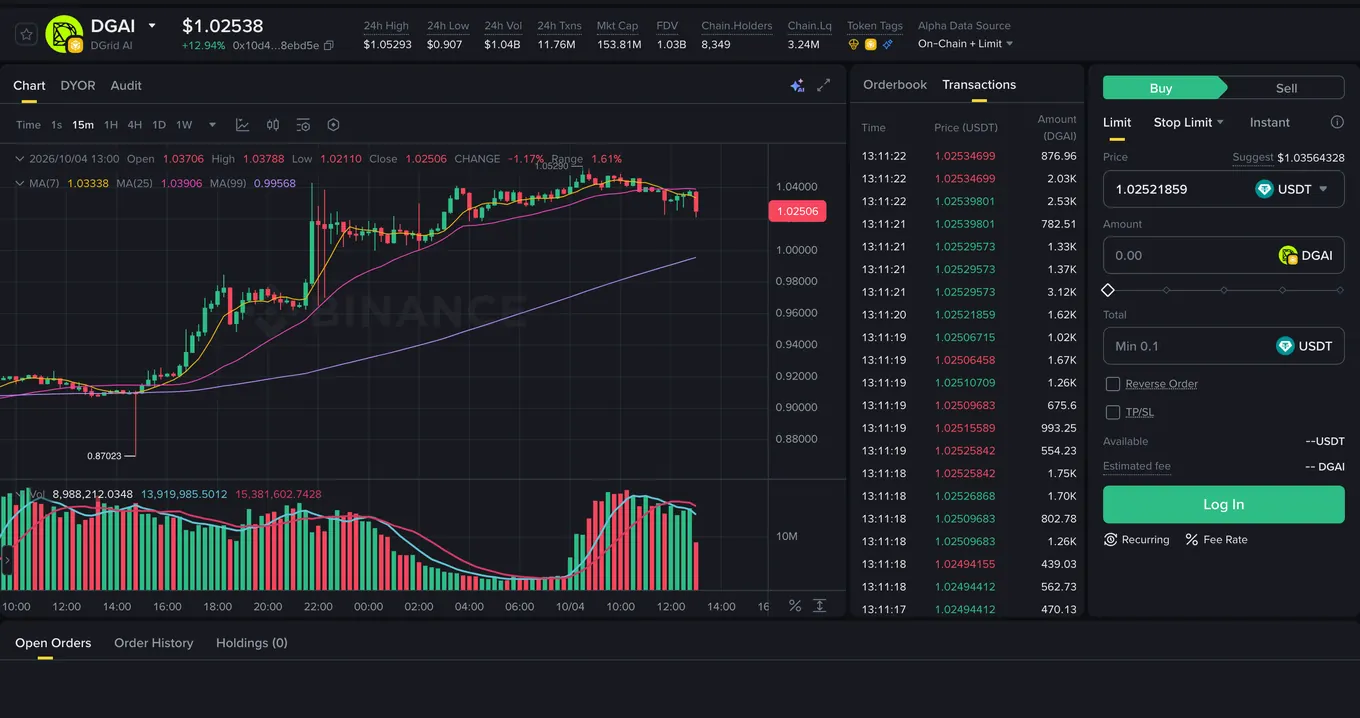
How Alpha differs from Binance Spot
- Earlier-stage tokens: most Alpha tokens are newly issued with small liquidity and market cap, so they move far more than major spot coins.
- Different execution: Alpha trades go through the Alpha section of the Binance app or Binance Wallet, usually backed by on-chain liquidity, so expect slippage and sometimes gas.
- Alpha isn't a spot listing: it's an observation zone; whether a token later lists on spot is a separate decision.
How to join an Alpha trading competition
- Create and verify a Binance account — see the Binance sign-up guide.
- Read the announcement: note the campaign period, eligible token and which trades count (some count only buys, others buys and sells).
- Some competitions require you to register on the campaign page first; trades before you join don't count.
- Trade the eligible token during the period and reach the minimum volume in the rules.
- Rewards are split either by volume ranking or equally among users who qualify, and are paid after the campaign — usually as token vouchers you claim in the rewards hub.
Every round's period, reward pool and requirement are on its campaign page, together with a comparison to the previous round.
Recent Alpha campaigns and frequency
In the last 90 days Binance and OKX published 27 Alpha campaigns, roughly one every 3.3 days; 25 published a reward pool (updated automatically as new announcements appear).
| Announced | Campaign | Reward pool | Period |
|---|---|---|---|
| Nov 20, 2026 | Binance Alpha Trading Competition: Trade Pieverse (PIEVERSE) and Share | 36,000 PIEVERSE | Nov 20 – Nov 27 |
| Nov 18, 2026 | Binance Alpha Trading Competition: Trade KiiChain (KII) and Share | 1,250,000 KII | Nov 18 – Nov 25 |
| Nov 13, 2026 | Binance Alpha Trading Competition: Trade Collect on Fanable (COLLECT) | 4,000,000 COLLECT | Nov 13 – Nov 20 |
| Nov 12, 2026 | Binance Alpha Trading Competition: Trade LAB (LAB) and Share $200K | 2,570,000 LAB | Nov 12 – Nov 19 |
| Oct 26, 2026 | Binance Alpha Trading Competition: Trade Axis Robotics (AXIS) and | 386,000 AXIS | Oct 26 – Nov 2 |
| Oct 22, 2026 | Binance Alpha Trading Competition: Trade Orochi Network (ON) and Share | 840,000 ON | Oct 22 – Oct 29 |
| Oct 20, 2026 | Binance Alpha Trading Competition: Trade NeoSoul (DNA) and Share $200K | 510,000 DNA | Oct 20 – Oct 27 |
| Oct 16, 2026 | Binance Alpha Trading Competition: Trade ACU (Acurast) and Share $100K | — | Oct 16 – Oct 23 |
The full list is in the Alpha history, sortable by date, token and pool:
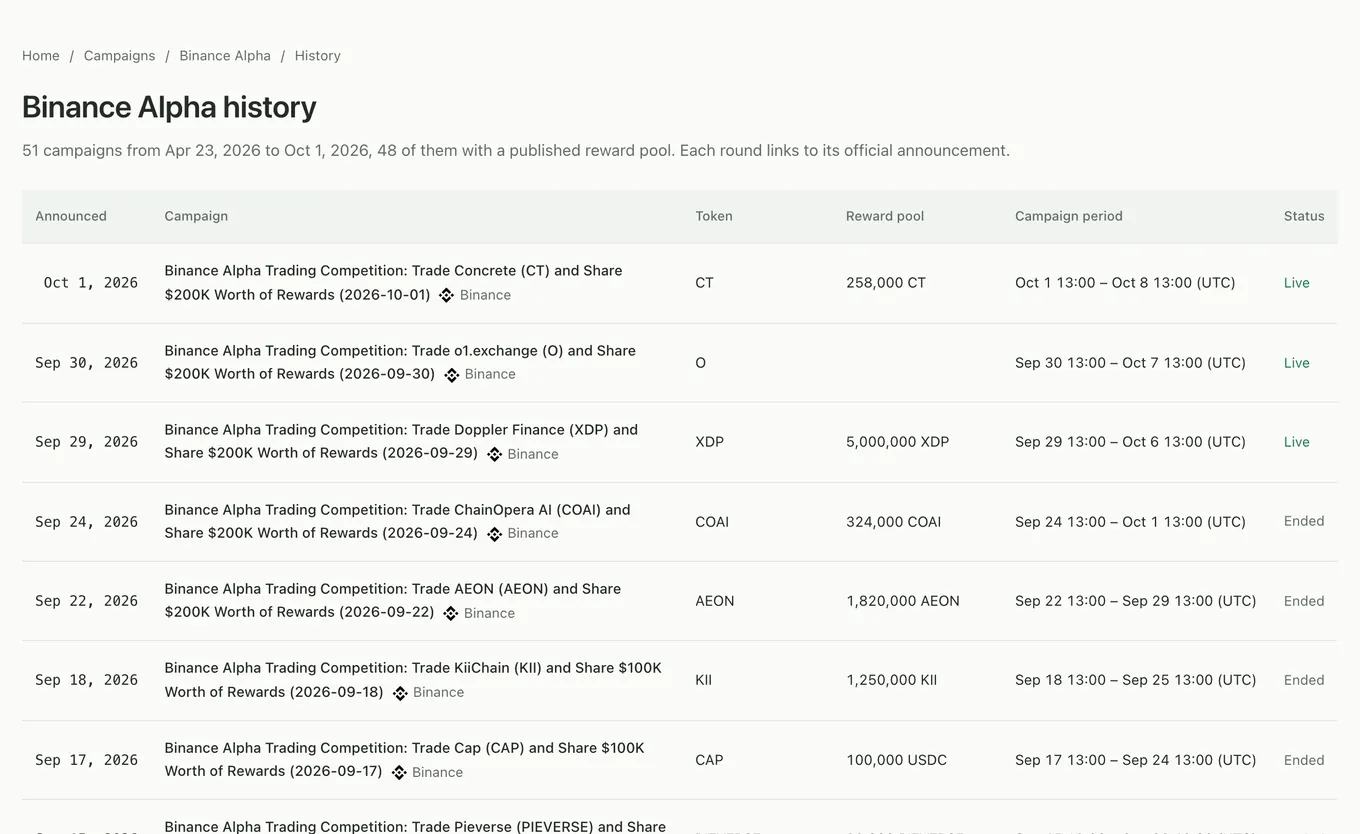
Most Alpha pools are paid as "tokens worth $X", so the token's own price decides what you actually receive.
The real cost: a worked example
Suppose a round requires at least 500 USDT of buys and splits the pool equally among qualifiers.
- Buying 500 USDT and selling it again with 0.5% slippage and 0.1% fees costs roughly 500 × (0.5% + 0.1%) × 2 ≈ 6 USDT.
- With a $200K pool and 20,000 qualifiers, each gets about $10; with 50,000 qualifiers it's $4 — a loss.
- Voucher tokens may be worth much less by the time they arrive.
So check the pool size, the previous round's number of qualifiers if published, and the token's liquidity before joining. The previous-round comparison on each campaign page shows whether this pool is large or small.
Is a round worth it? A five-step check
- Pool unit: USDT or tokens? Token pools move with the token price — value them at the current price.
- Split method: with an equal split, participation decides your share; with ranked prizes, ordinary accounts rarely place.
- Threshold and what counts: minimum volume? Buys only or both sides? Registration required?
- Your cost: threshold volume × (fee rate + expected slippage) × 2 for a round trip. Thinner books mean more slippage.
- Previous round: how big was the last comparable pool and threshold? Every campaign page shows past rounds and a Q&A.
If the cost from step 4 is more than half of the per-person reward you estimated in step 2, it's usually not worth joining.
Common pitfalls
- Cost of volume: thin liquidity makes slippage and fees from trading back and forth exceed the reward.
- Only some trades count: Convert, Buy Crypto and similar channels usually don't — the announcement says which.
- Wash trading: volume judged abnormal can be disqualified.
- Regional restrictions: some rounds exclude certain countries or regions.
- Token price risk: holding the token or the reward can lose value fast.
To compare campaign types on Binance and OKX, see Binance vs OKX; spot trading competitions are covered in the Binance trading competition guide.
How Alpha token prices tend to behave
Most Alpha tokens are newly issued, and a few patterns are worth knowing before you join:
- Volume spikes during competitions and fades after: price and volume often fall together once the round ends.
- Rewards arrive later: they're valued at the price when paid, which may be very different.
- Liquidity sits in a few pairs: large orders slip noticeably — split them or use limits.
The safest approach: trade only enough to qualify, flatten quickly, and don't hold large Alpha positions during the round.
FAQ
How often does Binance run Alpha competitions?
Very often — in recent months a new round every few days. Each campaign page shows how many rounds ran in the previous 90 days.
When are Alpha competition rewards paid?
Some time after the campaign ends, usually as token vouchers to claim in the rewards hub; the announcement gives the timing.
Do I need Binance Wallet to trade Alpha?
You can trade from the Alpha section of the Binance app; some campaigns, airdrops and on-chain tasks need Binance Wallet.
Are Alpha tokens safe?
They are high risk: mostly early projects with violent price swings. Only use money you can afford to lose.