Binance vs OKX (2026): Fees, VIP Tiers, Withdrawals and Key Differences
Binance vs OKX compared: spot and futures VIP tiers, USDT withdrawal fees by network, P2P and KYC, campaigns, scale and licenses — with monthly cost examples and which exchange suits you.
On this page
Short answer: for spot trading with BNB, Binance is cheaper (0.075% maker and taker with the BNB discount vs 0.1% taker on OKX). If you hold $100k+ but trade little, OKX gets you to VIP 1 on assets alone. Base futures fees are identical. Binance runs far more new-token campaigns; OKX's Web3 wallet is the better-regarded one. Most people open both and use whichever is cheaper for the job.
Binance and OKX are the two largest all-in-one crypto exchanges: spot, futures, earn, Web3 wallets and P2P on both. The real differences are fee and VIP rules, withdrawal networks, the kind and frequency of new-token campaigns, and KYC and regional policy. This guide compares them point by point. Regular-user fees update automatically from both fee pages (last checked 2026-10-28); the VIP tier tables come from Binance's fee page (checked 9 November 2026) and OKX's fee page (checked November 2026); licence and enforcement facts cite the announcement or press release they come from.
The short answer
- You want new-token campaigns (Launchpool, HODLer Airdrops, Megadrop, Alpha competitions): start with Binance, which runs the widest range and the most rounds.
- Mostly spot, fee-sensitive: Binance — with the BNB discount spot maker and taker are both 0.075%.
- Large balance, low volume: OKX — assets alone qualify for VIP, no volume or exchange token needed.
- Mostly futures or Web3 wallet: OKX's futures interface and on-chain wallet are well regarded, and base futures fees are identical.
- Most people: open both. Go wherever the campaign is, compare funding rates, and move funds between them when needed.
Binance vs OKX at a glance
| Binance | OKX | |
|---|---|---|
| Spot regular fees (maker / taker) | 0.1% / 0.1% | 0.08% / 0.1% |
| Exchange-token discount | BNB: 25% off spot, 10% off USDT-M futures | None |
| USDT-M futures regular fees | 0.02% / 0.05% | 0.02% / 0.05% |
| VIP qualification | 30-day volume and BNB balance | Assets or 30-day volume |
| Zero-fee pairs | Promotional, per the fee page | Some stablecoin pairs such as USDC-USDT are 0 / 0 |
| New-token campaigns | Launchpool, HODLer Airdrops, Megadrop, Alpha — the widest range | Jumpstart, listing competitions, boosted earn |
| First sign-up step | Email or phone | Choose country/region of residence first |
| Account structure | Spot, Funding, Futures wallets | Funding and Trading accounts |
| Own chain | BNB Smart Chain (BEP20) | X Layer |
| Main licenses | ADGM (Abu Dhabi) global license, per Binance's announcement | EU MiCA license (Malta), Dubai VARA, per OKX's announcements |
The sections below go through each one.
Which has lower fees, Binance or OKX?
Regular users
| Binance | OKX | |
|---|---|---|
| Spot maker / taker | 0.1% / 0.1% | 0.08% / 0.1% |
| Spot with exchange-token discount | 0.0750% / 0.0750% (BNB) | — |
| USDT-M futures maker / taker | 0.02% / 0.05% | 0.02% / 0.05% |
| Futures with exchange-token discount | 0.0180% / 0.0450% (BNB, 10% off) | — |
- Spot: without BNB, OKX maker (0.08%) beats Binance (0.1%) and taker is equal; with the BNB discount Binance is lower on both.
- Futures: identical for regular users; Binance is 10% cheaper with the BNB discount.
- Stablecoin swaps: OKX charges nothing on some stablecoin pairs such as USDC-USDT.
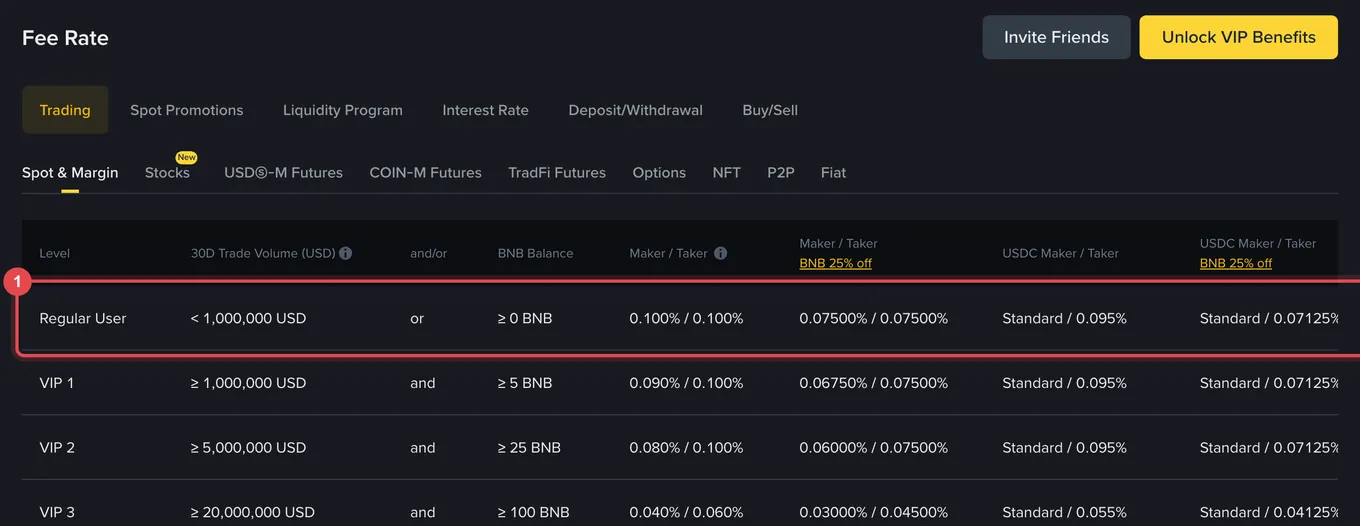
Spot VIP tiers side by side
Both run Regular plus VIP 1–9. Source: the Binance fee page (Spot tab, checked 9 November 2026), rates before the BNB discount; the OKX fee page (standard pairs such as BTC-USDT, checked November 2026). These are the same tables as in our Binance fees and OKX fees guides, which include screenshots:
| Tier | Binance: 30-day spot volume + BNB | Binance maker / taker | OKX: assets or 30-day spot volume | OKX maker / taker |
|---|---|---|---|---|
| Regular | — | 0.100% / 0.100% | — | 0.080% / 0.100% |
| VIP 1 | ≥ $1M + ≥ 5 BNB | 0.090% / 0.100% | ≥ $100k or ≥ $1M | 0.0675% / 0.080% |
| VIP 2 | ≥ $5M + ≥ 25 BNB | 0.080% / 0.100% | ≥ $200k or ≥ $5M | 0.060% / 0.070% |
| VIP 3 | ≥ $20M + ≥ 100 BNB | 0.040% / 0.060% | ≥ $2M or ≥ $10M | 0.055% / 0.065% |
| VIP 4 | ≥ $75M + ≥ 500 BNB | 0.040% / 0.052% | ≥ $5M or ≥ $20M | 0.030% / 0.045% |
| VIP 5 | ≥ $150M + ≥ 1,000 BNB | 0.025% / 0.031% | ≥ $20M or ≥ $100M | 0.025% / 0.035% |
| VIP 6 | ≥ $400M + ≥ 1,750 BNB | 0.020% / 0.029% | ≥ $50M or ≥ $200M | 0.000% / 0.030% |
| VIP 7 | ≥ $800M + ≥ 3,000 BNB | 0.019% / 0.028% | ≥ $100M or ≥ $500M | -0.001% / 0.023% |
| VIP 8 | ≥ $2B + ≥ 4,500 BNB | 0.016% / 0.025% | ≥ $250M or ≥ $1B | -0.0025% / 0.020% |
| VIP 9 | ≥ $4B + ≥ 5,500 BNB | 0.011% / 0.023% | ≥ $500M or ≥ $5B | -0.005% / 0.015% |
With the BNB discount, take 25% off the Binance columns — Regular becomes 0.075% / 0.075%. A negative OKX maker fee is a rebate: OKX pays you a little when your maker order fills.
Futures VIP tiers side by side (USDT-M)
Source: the USDT-M futures tabs of the same two fee pages, same check dates.
| Tier | Binance: 30-day futures volume + BNB | Binance maker / taker | OKX: assets or 30-day futures volume | OKX maker / taker |
|---|---|---|---|---|
| Regular | — | 0.0200% / 0.0500% | — | 0.0200% / 0.0500% |
| VIP 1 | ≥ $5M + ≥ 5 BNB | 0.0180% / 0.0500% | ≥ $100k or ≥ $5M | 0.0160% / 0.0450% |
| VIP 2 | ≥ $10M + ≥ 25 BNB | 0.0160% / 0.0400% | ≥ $200k or ≥ $10M | 0.0150% / 0.0360% |
| VIP 3 | ≥ $50M + ≥ 100 BNB | 0.0120% / 0.0320% | ≥ $2M or ≥ $50M | 0.0100% / 0.0280% |
| VIP 4 | ≥ $600M + ≥ 500 BNB | 0.0100% / 0.0300% | ≥ $5M or ≥ $200M | 0.0080% / 0.0270% |
| VIP 5 | ≥ $1B + ≥ 1,000 BNB | 0.0080% / 0.0270% | ≥ $20M or ≥ $600M | 0.0050% / 0.0260% |
At VIP 6 Binance is 0.0060% / 0.0250% and OKX is 0.0000% / 0.0250%; at VIP 9 Binance is 0.0000% / 0.0170% and OKX is -0.0050% / 0.0150%. Full tables are in the Binance fees guide and OKX fees guide. Binance futures fees get a further 10% off with BNB.
Three things to take from these tables:
- Binance needs volume and BNB together — holding BNB without the volume leaves you Regular. OKX needs assets or volume — $100k in the account is VIP 1.
- At the same tier OKX is usually slightly cheaper, but Binance stacks the BNB discount on top. For a Regular spot user with BNB, Binance wins.
- The thresholds are far away for most people: $1M of spot volume in 30 days is about $33k a day. Don't churn volume just to level up.
What the difference costs per month
Calculated from the regular and VIP 1 rates in the tables above (fee = volume × rate):
| Your situation | Binance | OKX |
|---|---|---|
| 10,000 USDT spot a month, all taker | 10 USDT; 7.5 USDT with BNB | 10 USDT |
| 10,000 USDT spot a month, all maker | 10 USDT; 7.5 USDT with BNB | 8 USDT |
| 1M USDT futures a month, all taker, Regular | 500 USDT; 450 USDT with BNB | 500 USDT |
| Same, OKX balance ≥ $100k (VIP 1) | 500 USDT; 450 USDT with BNB | 450 USDT |
Small spot traders differ by a few USDT a month — turning on the BNB discount matters more than which exchange you pick. Only at large futures volume do the maker share and VIP tier open a real gap. The fee calculator shows monthly and yearly fees on both for your own volume and maker share. For most people, campaigns and funding rates matter more than base fees.
USDT withdrawal fees by network
Neither exchange charges for crypto deposits. Withdrawals cost a flat amount per coin and network, whatever the size: 100 USDT and 10,000 USDT pay the same fee.
What we have on record for Binance USDT (from our screenshots of Binance's withdrawal page, October 2026):
| Network | What the page showed | Watch out for |
|---|---|---|
| BNB Smart Chain (BEP20) | A note saying USDT on BSC had the lowest withdrawal fee | The receiving side must support BEP20 |
| Tron (TRC20) | 1.50 USDT fee, 5 USDT minimum | Fees change with network conditions |
| To a Binance user (internal transfer) | Sent between Binance accounts without going on-chain | Only works between Binance accounts |
At that TRC20 fee, withdrawing 100 USDT costs 1.5% of the amount, while 1,000 USDT costs 0.15% — which is why the network matters most for small transfers.
OKX lists its fee and minimum for every network on its withdrawal fee page and on the app's withdrawal screen. OKX also has its own network, X Layer; if the receiving platform or wallet supports it, compare its fee there too.
When choosing a network:
- Fees change: both exchanges say fees follow network conditions. To compare, open the withdrawal screen on each, enter USDT, and switch between networks — the fee and minimum update for each one. Trust what the screen shows at the time.
- The cheapest network may not be supported on the other side: check the recipient's deposit page first, then pick the cheapest network both support.
- Networks must match: withdraw on the same network as the deposit address you copied, or the funds may be unrecoverable. Step-by-step: how to transfer from Binance to OKX.
- Batch small transfers: the fee is flat, so one larger transfer beats several small ones.
New-token campaigns: Binance has more
- Binance: Launchpool (stake BNB, FDUSD and others to farm new tokens), HODLer Airdrops (BNB in Simple Earn receives airdrops automatically), Megadrop (lock BNB plus Web3 quests), Binance Alpha competitions and airdrops, and spot trading competitions. Keeping BNB in Simple Earn is enough to receive HODLer Airdrops passively.
- OKX: Jumpstart (stake OKB and others to farm new tokens), listing trading competitions, and boosted-APR Simple Earn and On-chain Earn promotions.
We track both exchanges on the campaigns page, with dates, reward pools and requirements on each campaign page. The monthly reports compare how many campaigns each exchange ran per month.
How often campaigns actually run
What matters is frequency and reward size. From the announcements we track over the last 90 days (updated automatically):
- Trading competitions: In the last 90 days Binance and OKX published 39 trading competitions, roughly one every 2.3 days; 39 published a reward pool, with a median dollar/stablecoin pool of about $200K (updated automatically as new announcements appear).
- Binance Alpha: In the last 90 days Binance and OKX published 27 Alpha campaigns, roughly one every 3.3 days; 25 published a reward pool (updated automatically as new announcements appear).
- Earn promotions: In the last 90 days Binance and OKX published 42 earn promotions, roughly one every 2.1 days; 25 published a reward pool, with a median dollar/stablecoin pool of about $200K (updated automatically as new announcements appear).
- HODLer Airdrops: No new HODLer Airdrop in the last 90 days.
Futures: same fees, different funding
Both offer USDT-margined and coin-margined perpetual and delivery futures with the same base fees for regular users. The differences are:
- Funding rates: the same coin can have very different funding on the two exchanges, and for a held position this costs more than trading fees. See the funding rate table and the cross-exchange spread page.
- Listing speed: a hot new token's perpetual sometimes lists on one exchange days before the other.
- Margin tiers: maintenance margin rises with position size and the tier brackets differ between exchanges — large traders should check both.
- Interface: try placing orders, take-profit/stop-loss and leverage changes with a small amount on both.
The coins with the biggest funding gap between the two right now (both sides above $1M of volume, live):
| Coin | Annualized gap | 7d avg gap | Hedge |
|---|---|---|---|
| INIT | 287.0% | 133.8% | Short Binance / long OKX |
| ONE | 193.1% | 15.1% | Short OKX / long Binance |
| IRYS | 110.1% | 12.3% | Short Binance / long OKX |
| BABY | 84.8% | 17.6% | Short Binance / long OKX |
| MOODENG | 83.3% | 6.5% | Short OKX / long Binance |
That gap is what cross-exchange funding arbitrage trades — see the funding arbitrage guide.
Earn and wallets
- Earn: Binance Simple Earn has flexible and locked products, and BNB in it also qualifies for HODLer Airdrops. OKX Simple Earn and On-chain Earn are equally broad. Both run new-user and limited-time boosted APR offers — see earn promotions.
- Web3 wallets: both have built-in on-chain wallets. Binance Alpha trading and some Megadrop quests use Binance Wallet; OKX Wallet supports a very wide range of chains and dApps.
P2P and sign-up: what's different
Buying USDT with P2P
Both let you buy and sell USDT for local currency via P2P, and the flow is the same: pick currency and payment method, choose a merchant, pay, wait for release. The details differ:
| Binance P2P | OKX P2P | |
|---|---|---|
| Fee for ordinary users placing an order | None (taking an existing ad is free) | None |
| Fee for merchants posting ads | Varies by fiat market, see Binance's P2P fee page | See OKX's P2P page |
| Where the coins land | Funding wallet | Funding account — transfer to Trading before you trade |
| Requirement | Verified identity, payment method in your own name | Same |
(Fees as stated on each exchange's P2P pages; those pages prevail.) P2P prices usually sit a little above market and differ between the two at any moment, so check both before you order. Merchant selection and scam warnings: how to buy USDT with P2P.
Registration and KYC
| Binance | OKX | |
|---|---|---|
| Sign up with | Email or phone | Choose country/region first, then email or phone |
| Referral code | Entered on the sign-up page; usually can't be added later | Same |
| KYC needs | ID card, passport or driving licence, plus face check | Same |
| KYC unlocks | Fiat deposits, P2P, withdrawals, most campaigns | Same |
| Difference | Verification page lists fiat, crypto and P2P limits by level | Different entities serve different regions, so the residence you pick decides which features you get |
On both, one identity can verify only one main account — never borrow or lend a verified identity. Full steps: Binance sign-up guide and OKX sign-up guide.
Scale and regulation: which is more legitimate?
| Binance | OKX | |
|---|---|---|
| Founded | 2017 | 2017 (formerly OKEx) |
| Main licenses | Global license under the ADGM (Abu Dhabi) FSRA framework, per Binance's own announcement | EU MiCA license from Malta's MFSA, passported across the EEA, per OKX's January 2025 announcement; Dubai VARA |
| US enforcement | November 2023: pleaded guilty and agreed to pay over $4.3B (US Department of Justice press release) | February 2025: pleaded guilty to operating an unlicensed money transmitting business and agreed to pay over $504M (US Department of Justice press release) |
| Proof of Reserves | Published regularly | Published regularly |
How to read this:
- Both have a US enforcement history, from past lax handling of US users and anti-money-laundering controls. Both tightened KYC afterwards, which is part of why verification is stricter today.
- License coverage differs: European users get an MiCA-licensed OKX entity; Binance's global platform is supervised from Abu Dhabi. Which entity serves you depends on the residence you register with.
- Size isn't safety: any funds on any exchange carry platform risk — see "Managing the risk of funds on exchanges" below.
Security settings and restricted regions
Both publish Proof of Reserves and support authenticator 2FA, anti-phishing codes and withdrawal whitelists. Note that both main platforms do not serve residents of restricted regions such as mainland China and the United States. Check that your jurisdiction isn't restricted and follow local law.
Which suits your situation
| Your situation | Better fit | Why |
|---|---|---|
| You hold BNB and want new tokens passively | Binance | BNB in Simple Earn earns HODLer Airdrops; Launchpool is BNB-centric |
| You chase trading competitions and Alpha | Binance | The most competitions and Alpha rounds — see the 90-day stats above |
| Mostly spot, fee-sensitive | Binance | With BNB, spot maker and taker are both 0.075% |
| Mostly futures | Both | Same base fees; pick per trade by funding and margin tiers |
| Larger balance, trade rarely | OKX | Assets alone can qualify for VIP |
| You swap stablecoins often | OKX | Some stablecoin pairs such as USDC-USDT are fee-free |
| Heavy on-chain wallet and dApp use | OKX | OKX Wallet supports a very wide range of chains and dApps |
| You live in the EEA | OKX | OKX has an MiCA-licensed entity |
| Beginner who just wants to buy and hold | Either | Learn one exchange's deposits, buying and security first |
Managing the risk of funds on exchanges
- Don't keep everything on one exchange — using both already spreads platform risk.
- Long-term holdings can move to a wallet you control; keep on exchanges what you need for trading and campaigns.
- Turn on every security setting: authenticator, anti-phishing code, withdrawal whitelist — see both sign-up guides.
- Check Proof of Reserves: both exchanges publish it regularly on their websites.
How to choose
- Decide what you'll do most: new-token campaigns, spot DCA, earn, or futures.
- Run your volume through the fee calculator.
- Holding both accounts is fine. Use a referral code when you sign up — the referral link can usually only be set at registration. Step-by-step: Binance sign-up guide and OKX sign-up guide.
FAQ
Which has lower fees, Binance or OKX?
Regular futures fees are identical (0.02% maker, 0.05% taker). For spot without BNB, OKX's maker fee is lower; with the BNB discount Binance is lower on both maker and taker (0.075%). Tier for tier OKX is slightly cheaper, but Binance stacks the BNB discount on top.
What is the main difference between OKX and Binance?
Binance runs more new-token campaigns, offers a BNB fee discount and requires volume plus BNB for VIP. OKX has no exchange-token discount but grants VIP on assets alone, charges nothing on some stablecoin pairs, and has its own X Layer network and a well-regarded Web3 wallet.
Which is cheaper for withdrawals?
It depends on the network. When we captured Binance's withdrawal page in October 2026, BEP20 was flagged as the cheapest network for USDT and TRC20 cost 1.50 USDT; OKX also offers its own X Layer network. Between the two, only networks both support will work — go by the fee shown on the withdrawal screen.
Is Binance or OKX safer?
Both publish Proof of Reserves and both hold major licenses: Binance under ADGM in Abu Dhabi, OKX under MiCA in the EU. Both have settled with the US Department of Justice in the past. No exchange is risk-free, so spread large holdings and turn on every security setting.
Which P2P is better?
Ordinary users pay no fee to place P2P orders on either, and the flow is similar. The differences are the live price and how many merchants are active — check both and pick a merchant with many completed orders and a high completion rate.
Can I have accounts on both Binance and OKX?
Yes. They are separate companies and holding both is common; many users simply go wherever the campaign is.
Which should a beginner open first?
If you want "free new token" campaigns such as Launchpool and HODLer Airdrops, start with Binance. If you mostly want an on-chain wallet or futures, OKX is a good first choice. Most users end up using both.
Can US residents use Binance or OKX?
Not the main platforms — both list the United States, mainland China and other regions as restricted, and registration or KYC from a restricted residence will fail. Follow your local law.